

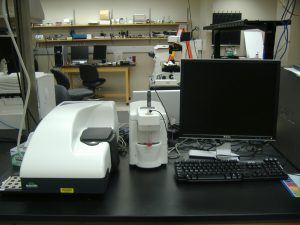
Zetasizer
About
The Zetasizer Nano-ZS can measure (1) particle size of particles and molecules from 0.6 nm to 6 micrometers using non-invasive back-scatter (NIBS) technology and dynamic light scattering, (2) zeta potential in aqueous and non-aqueous dispersions using M3-PALS technology, and (3) molecular weight with an absolute measurement using static light scattering and the sensitivity from an avalanche-photodiode detector and fiber detection optics. The Nano-ZS can measure all three parameters with no performance compromises and allows measurements of samples with little or no dilution. The unique disposable zeta potential cell ensures no cross contamination of samples.
Fees
Zetasizer usage is $19/hour. The users must log into the log book and the individual Excel sheet prior to using the instrument for billing purposes. The log book comments will help in assessing a possible malfunction which may occur during the user’s time.
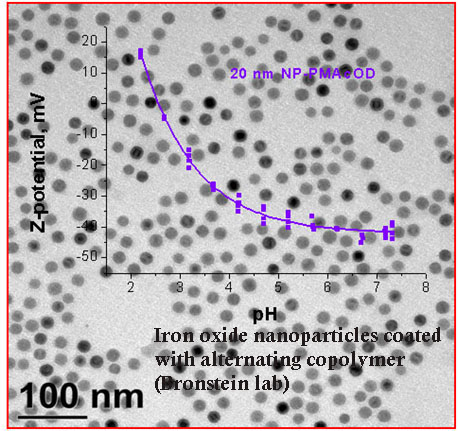
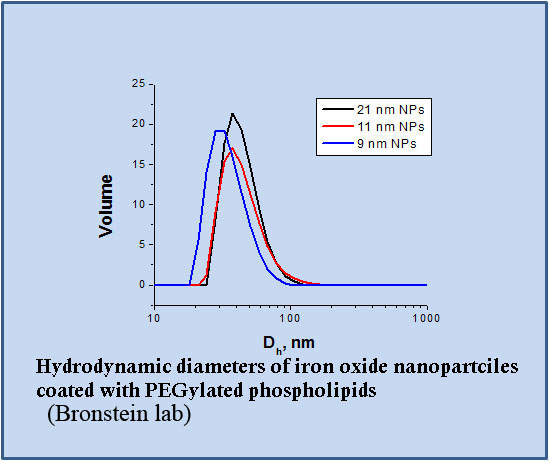
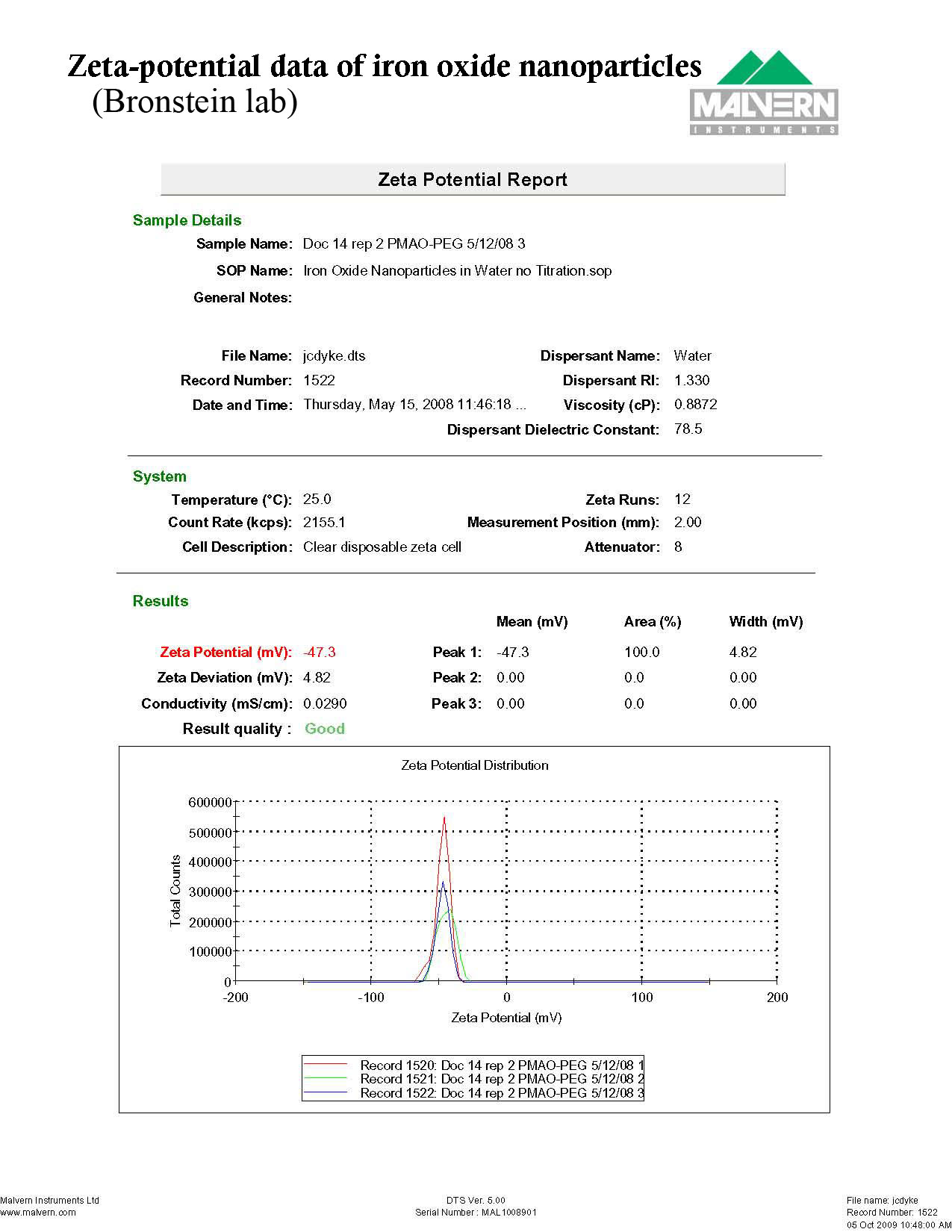
Research Examples
FAQs
Zetasizer nano uses a laser with λ=633 nm. Samples that absorb in this region are not suitable for analysis. The instrument has a temperature controller capable at examining samples from 2oC to 90oC. Contact the supervisor prior to performing experiments at high or low temperatures.
Low volume quartz cuvette is available for check out. Disposable polystyrene cuvettes are available at the instrument. “Disposable” multiuse folded capillary polystyrene cuvettes for size/zeta measurements are located by the instrument.
Disposable polystyrene cuvettes require 1 mL of a sample, folded capillary cells take 0.75 mL. The minimum volume of a sample for low volume quartz cell is 12 μL.
There is not an easy answer for this question as it depends on the optical properties of the particles, the particle size and polydispersity of the sample. In general, samples for zeta potential measurements have to be optically clear or only slightly turbid. To achieve the best results, a concentration series should be done. Samples showing “Attenuator” values of 6-9 are generally preferred. An attenuator value of 11 indicates that full laser power is used for data collection, as such, the concentration of your sample should be increased.
The instrument measures the intensity of scattered light; it is the most accurate measurement. Volume and number distributions are calculated from the intensity. Intensity generally should be used, particularly for samples of uniform size. It can be hard to interpret the data, if the sample contains a wide range of sizes or even a small amount of a large contaminant. Volume and number distributions can then be used to compare sizes from sample to sample. However, in that case, accurate values for refractive index should be used in SOP preparation as these values are used to calculate volume data from the intensity through the Mie theory. Consult Pg. 14-15 of the manual.
Refractive index and absorption of the material are necessary for accurate Intensity to Volume conversion. Although, for particles of ~63 nm and smaller in diameter these values do not have to be accurate because the Rayleigh theory dominates in this regime, as a particle size is much smaller than the wavelength of light.
For explanation of parameters that might be displayed here consult pages 5-10 for size measurements and pages 5-15 for zeta measurements.
The polydispersity index (PDI) is a number calculated from a simple two parameter fit to the correlation data called a cumulants analysis. The Polydispersity index is dimensionless and scaled such that values smaller than 0.05 are rarely seen other than with latex standards. The various size distribution algorithms work with data that falls between these two extremes. The maximum value is arbitrarily limited to 1.0. A PDI value of 1 indicates that the sample has a very broad size distribution and may contain large particles or aggregates that could be slowly sedimenting. If this is the case, the sample may not be suitable for a DLS measurement. The refractive index is only required if a Mie transformation is done. So the Z-Average size and the intensity distribution do not require this value, only the transformation to volume and number distributions does.
Absolutely yes.
Contact
Tanner Young
Simon Hall 002B
Email: youngtaw@iu.edu